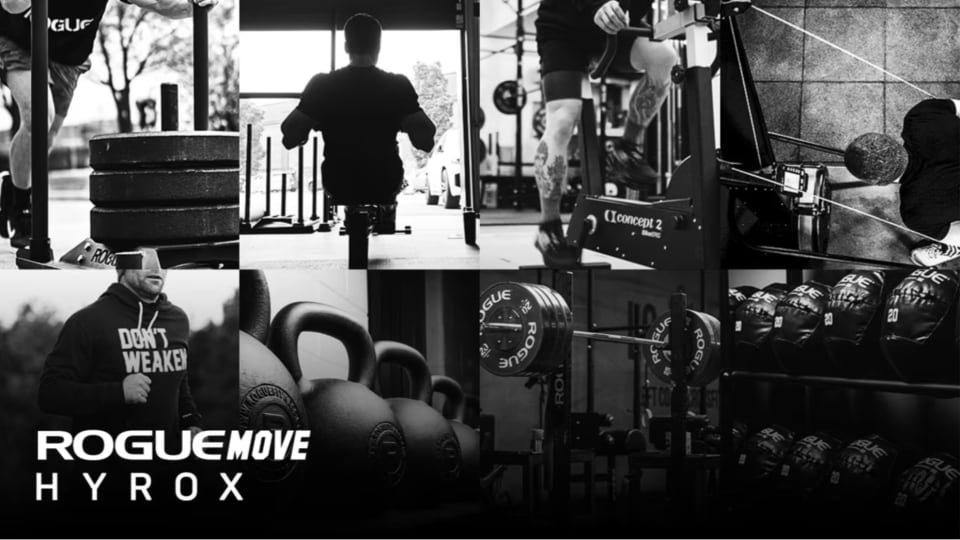

























HYROX Techniques & Training: Everything You Need to Know for Race Day
HYROX is a fitness race designed for everyday athletes all the way through elite fitness racers. The workout is standardized across the world so times can be compared regardless of the race location.
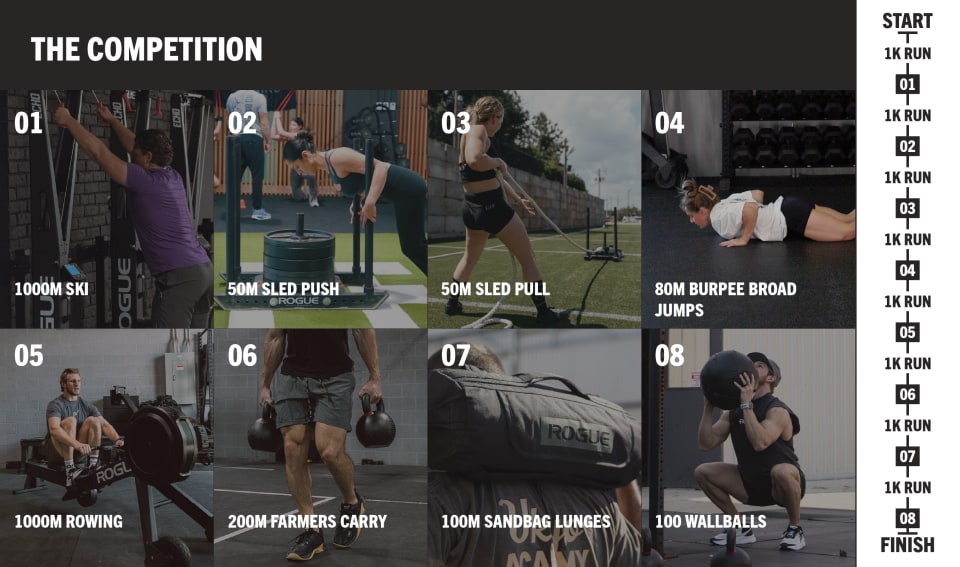
In total the race is composed of 8km of total running and eight workout stations.
Every race follows the same structure:
- 8 x 1km runs
- Each run is followed by one functional workout station
But how do you execute and get better at these movements? We have you covered…
Station 1: 1000m Ski
The ski simulates cross country skiing, engaging the arms, back, core and legs in this full body exercise. Technique is key when using this machine to help you be efficient and save energy:
1. The “Catch” (Starting Position)
- Stand tall, feet shoulder width apart, about 18-24 inches from the flywheel.
- Arms should bend to approximately 90 degrees to get tension on the cables.
- Brace ready to hinge.
2. The “Drive” (Pulling Phase)
- Initiate by hinging the hips back and then down bending at the knees.
- Chest and head should travel down, but don’t let the shoulders go deeper than the hips.
- After initiating the movement with the hips pull the handles to your “pockets”: Aim to pull the handles down to your thighs/knees, but not past them, to maintain efficiency.
- Focus on using your bodyweight and core to move the handles.
- Arms extend after hips have hinged.
3. The “Recovery” (Returning Phase)
- Stand up tall and elevate the arms.
- The recovery phase should be smooth and be used to breathe to prepare for the next stroke.
Common Technique Mistakes to Avoid
- Using the arms to pull on the handles before hinging with the hips. This is inefficient and will fatigue the arms quickly.
- Squatting the movement instead of hinging the hips.
- Letting the shoulders go deeper than the hips. Again, this is inefficient and will fatigue the lower back.
If you are looking at getting better at ski machines a simple training progression could be:
Week 1: 250m Ski, Rest 2 mins x 6
Week 2: 500m Ski, Rest 3 mins x 5
Week 3: 750 Ski, Rest 4 mins x 4
Week 4: 1km Ski, Rest 4 mins x 3
Week 5: 1km Ski, Rest 3 mins x 3
Week 6: 1km Ski, Rest 2 mins x 3
Week 7: 1km Ski, Rest 1 min x 3
Week 8: 1km Ski Test to gauge your pace for your HYROX Race
A few points to remember with regard to the ski station:
- The monitor must be (re)set by a referee.
- Your feet must remain on the platform at all times during the ski.
- Once you have completed 1000m you must raise your arm to call over a referee to confirm the required distance has been completed, after receiving confirmation from the judge, you may exit the Ski Station
Station 2: 50m Sled Push
The sled push isn’t a highly technical movement, but it’s heavy and demands solid leg strength to execute well. Preparing for this race element starts with building that lower-body strength. Along with getting time on the sled, prioritize compound lifts like squats and deadlifts using a barbell and a reliable squat stand to drive real strength gains. Technique still matters: focus on maximizing horizontal force as you push. Test whether extended arms or a shoulder-drive position feels better, and adjust your contact point on the sled arms until you’re pushing at a height that directs power straight forward rather than tilting the sled into the ground. Training with a Dog Sled or Echo Dog Sled will give you the closest feel to what you’ll face on race day.
For a full breakdown on how to train with the Dog Sled, check out the article here.
Sled Weights:
WOMEN: 225lbs (102kg) (including sled)
WOMEN PRO / MEN: 335lbs (152kg) (including sled)
MEN PRO: 445lbs (202kg) (including sled)
A few points to remember with regard to the sled push station:
- You and your sled have to stay in your allocated lane.
- The entire sled must be passed the start/finish line.
- You must complete 4 x 12.5m pushes.
Station 3: 50m Sled Pull
Station 3 is more grunt work, using a rope to pull a sled 50m. The sled pull station will test your grip endurance, upper body strength and to be efficient you will have to learn to use your legs and hips in coordination with the upper body. Again, building up leg strength by squatting and deadlift is key, but you will also want to improve your upper body strength, so add bent over rows, pull ups, hammer curls and specific grip strength training (will also help with the farmers carry station).
Sled Weights:
WOMEN: 172lbs (78kg) (including sled)
WOMEN PRO / MEN: 227lbs (103kg) (including sled)
MEN PRO: 337lbs (153kg) (including sled)
A few points to remember with regards the sled pull station:
- You must stay inside your allocated athlete box while pulling the sled.
- Your rope must stay inside your box and not interfere with the lanes adjacent to you.
- The entire sled must be passed the 12.5m mark before you switch and pull the sled back.
- You must complete 4 x 12.5m pulls.
Station 4: Burpee Broad Jump
The burpee broad jump station will test your conditioning and explosive hip power. This movement has the ability to jack up your heart rate, so practicing and becoming efficient at this low skill movement will set you up for success. Utilize movements like the push up and bench press, squat jumps and kettlebell swings to prepare for this station.
Distance 80m (unless penalties are assessed)
A few points to remember with regard to the burpee broad jump station:
- Once your hands are placed on the ground they cannot be moved forward.
- Your chest must touch the ground.
- When getting up from the bottom position, your feet cannot pass the position where your hands were placed on the floor.
- Both feet must jump and land simultaneously.
- Taking any steps forward between the repetitions is not allowed.
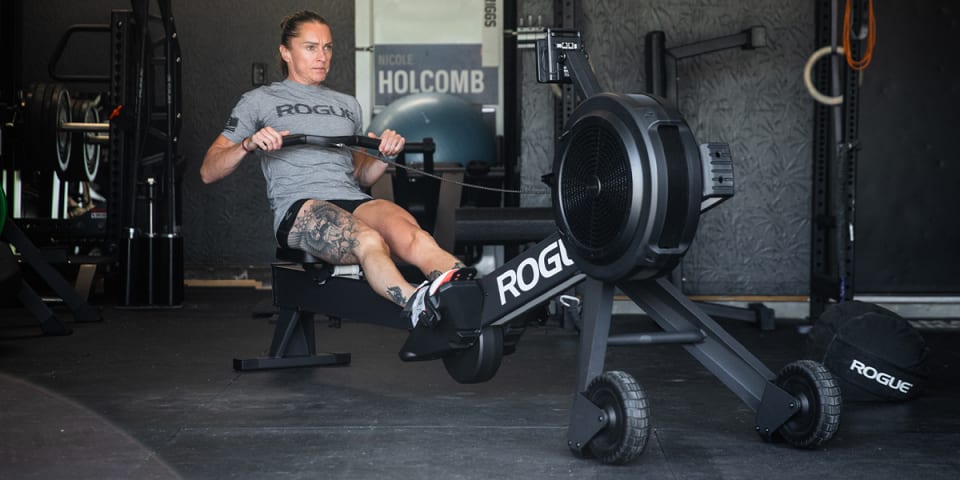
Station 5: 1000m Row
The rower is a great whole body conditioning tool, which has a relatively low impact on the joints. The row station will test your aerobic capacity and muscle stamina, with good technique being a big advantage:
1. The Drive (Power Phase)
- Catch Position: Sit tall with your shoulders in front of your hips, heels should be on the foot pad which means your shins will be close to vertical. Keep your arms straight and brace your core ready to start the drive.
- Leg Drive: Initiate the stroke by driving through your heels into the foot pads.
- As the knees extend we can start to open the hip which can be called the “Body Swing.” Ensure your core is braced and arms long – think 1 o’clock on a clock face.
- Arm Pull: Once the torso angle is slightly leaning back you can pull with the arms, drawing the handle to your lower ribs, keeping a proud chest and flat back.
2. The Recovery (Return Phase)
- Arm Extension: After the handle reaches your chest, extend your arms, and then chase the handle forwards with your torso.
- Your torso can lean forwards to about 11 o‘clock on the Body Swing forward: Once your arms are straight, hinge forward from the hips, leaning your body toward the front of the rower.
- Leg Slide: Continue the forward movement by bending your knees and sliding the seat forward until your shins are vertical again, returning to the catch position.
The sequence is key: Legs, body, arms, arms, body, legs. Focus on your legs – 60% of the power is from the legs, 30% body, 10% arms. And throughout the movement, maintain good core stability.
Common Technique Mistakes to Avoid:
- Driving through the toes and not the heels.
- Swinging the torso backwards to initiate the drive.
- Pulling early with the arms and overgripping the handle.
- Not reaching full knee extension before the return phase.
- Bending the legs before the arms have past the knees on the return phase.
If you are looking at getting better at the rower you could follow a similar training progression to that of the ski machine above. We would also recommend some longer, slower sessions to dial in technique and become efficient also. Programs like the Echo Row or the Echo Row – 2k are great options to help you improve pacing, reinforce proper mechanics, and build the aerobic engine you’ll need on race day.
A few points to remember with regards the row station:
- The monitor must be (re)set by a referee.
- Your feet must remain on the platform at all times during the ski.
- Once you have completed 1000m you must raise your arm to call over a referee to confirm the required distance has been completed, after receiving confirmation from the judge, you may exit the station.
Station 6: Farmers Carry
The farmers carry is a great strength and conditioning movement that will tax your grip, shoulders and core. Holding and walking with a weight doesn’t sound like much, but when you factor in that it’ll jack up your heart rate, and fatigue your posture, which can impact your breathing, don’t overlook this station and train for it to make it as easy as possible.
To train for farmer carries focus on short and long carries with various loadings. During a HYROX race you will be using kettlebells, but you can easily train different loads with one tool using a pair of farmers walk handles. You can do single arm or double arm which will train your core and posture. Improve your grip strength by doing deadhangs from a pull up bar, use a towel for towel pull ups or a pair of Grandfather Grips, and train your core by building in planks, heavy front rack holds, and sandbag bear hug carries and holds.
A few points to remember for the farmers carry station:
- If you are in motion you have to be carrying the kettlebells.
- Kettlebells must be carried in the farmers carry position with the arms extended.
- You can put the kettlebells down to rest.
- The station is completed, once the athlete carries the kettlebells across the finish line and returns them to the marked area.
Distance: 200m
WOMEN: 2 x 16kg – 35lbs
WOMEN PRO / MEN: 2 x 24kg – 53lbs
MEN PRO: 2 x 32kg – 70lbs
Station 7: Sandbag Lunges
The sandbag lunges will test your individual leg strength and stamina combined with core strength. At this stage of the race you are fatigued and tired, so your balance and coordination will also be tested. Training your leg and core strength is the best way to prepare for this station. Look at training movements like bulgarian split squats, all variations of lunges with different equipment, weighted step ups, sandbag holds, and planks.
A few points to remember for the sandbag lunge station:
- Lift the sandbag into position without assistance.
- Start by standing tall with both feet behind the line.
- Your back knee must touch the floor on every lunge.
- Stand tall with knees and hips fully extended to complete a repetition.
- You must alternate legs each time you lunge.
- You may rest during the lunges, standing tall holding the sandbag.
- Taking any steps between repetitions is not allowed.
- The station is complete when you cross the finish line and return the sandbag to the marked area.
- You are not allowed to put the sandbag down, it has to stay on the shoulders.
Distance: 100m (unless penalties are assessed)
WOMEN: 22lbs (10kg)
WOMEN PRO / MEN: 44lbs (20kg)
MEN PRO: 66lbs (30kg)
Station 8: Wall Balls
The wall ball combines a front squat and the explosive nature of a push press where we squat and throw a medicine ball to a target. This movement therefore requires strong legs, explosive hip extension, and shoulder stamina combined with coordination under fatigue.
Build your legs, focus on front squats, lunges, become competent using your hip to create power, train kettlebell swings, box jumps, power cleans, push presses, and include thrusters in your programming.
A few points to remember for the wall ball station:
- Start by holding the ball standing tall. You cannot scoop up the ball into the bottom of a squat to start.
- Ensure you squat to a depth below parallel (the hips must be lower than the knees) before standing tall and throw the ball to the target.
- The ball must hit your designated target.
- If you don’t catch the ball you have to pick up the ball and stand tall before starting the next rep.
- The judge may bring you a box to squat to if you are not going deep enough.
WOMEN: 75 reps with a 9lbs (4kg) medicine ball
WOMEN PRO / MEN: 100 reps with a 13lbs (6kg) medicine ball
MEN PRO: 100 reps with a 20lbs (9kg) medicine ball
*Target height WOMEN and WOMEN PRO: 9’
*Target height MEN and MEN PRO: 10’
Rogue Move HYROX eBook
For a full training guide that includes pacing, technique, and station-specific strategy, the Rogue Move HYROX eBook gives you a structured guide to train smarter for race day. As a digital affiliate of HYROX, Rogue provides a program aligned with the demands of the event—a complete 8-week plan built to prepare you for a HYROX race or similar fitness competition, whether you’re lining up for the first time or aiming to improve on a previous finish. HYROX combines functional strength work with sustained endurance, and this guide targets every element you’ll face on the course—running, station strength, and the metabolic demand that brings it all together.
Each training week includes dedicated running sessions, focused strength work, conditioning pieces, and race-specific sessions that blend HYROX-style movements in realistic combinations. Most workouts run 60-90 minutes, giving you enough volume to build capacity efficiently without dragging out your training day.
For more information on the HYROX race, check out the link here.